
Like the NFRD, the CSRD sets out environmental, social and governance (ESG) reporting requirements for companies. It aims to significantly expand the scope of the NFRD, both in terms of who must report and what they must report.
The EU has long believed that investors and consumers have a right to understand the ESG impact of companies in a clear and easily comparable way. While existing regulations (such as the NFRD) were a step in this direction, the consensus was that they were not sufficient.
The CSRD aims to establish a common framework for non-financial reporting. The idea is that by mandating comprehensive, robust and standardised reporting, everyone - from policy makers and investors to customers and consumers - will be able to make informed decisions about a company's ESG performance.
GESVALT has extensive experience in advising companies on reporting and preparing them for the new sustainable challenges ahead.
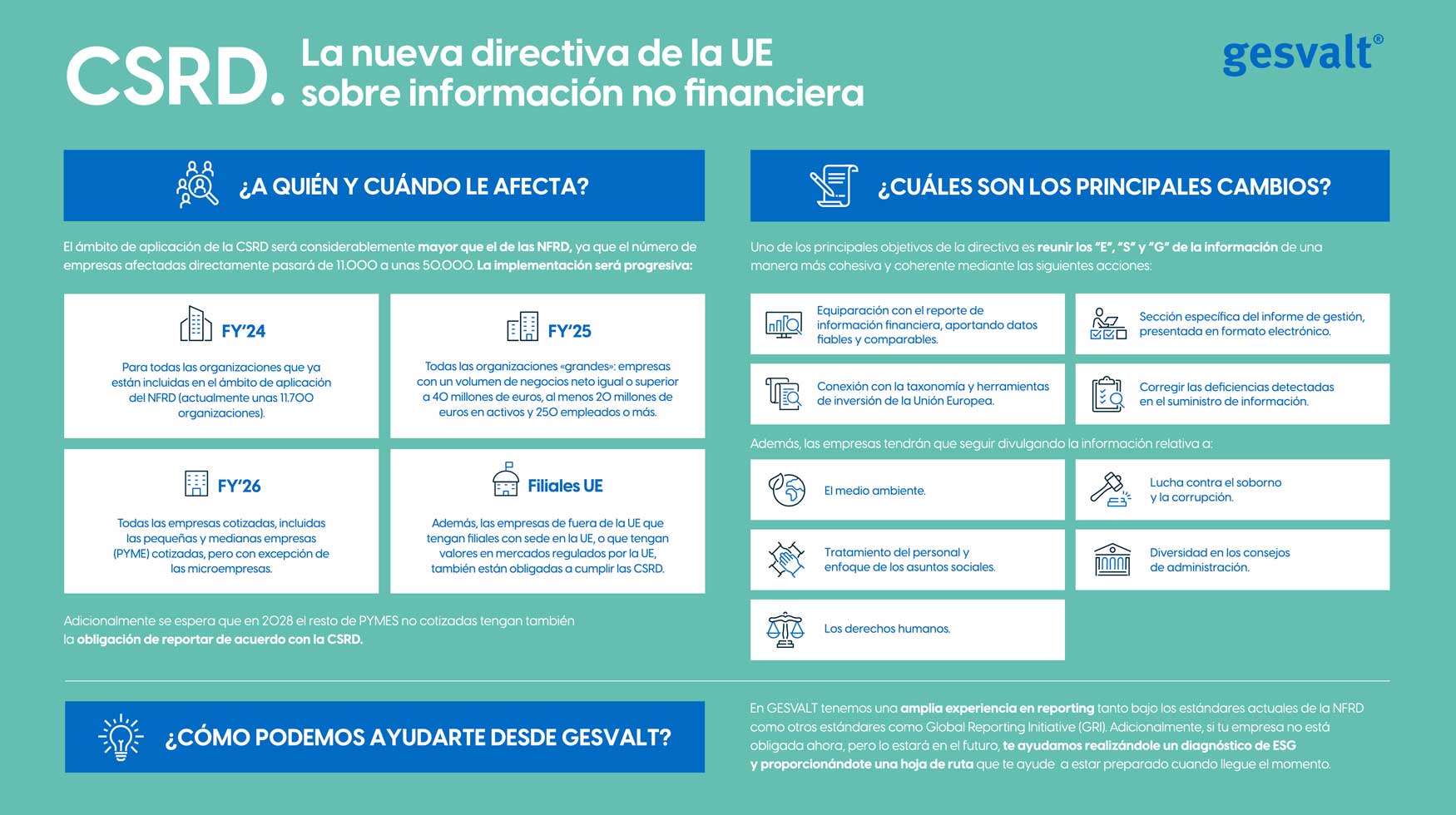
Who is affected by the new CSRD and when?
The scope of the CSRD will be considerably larger than that of the NFRD, as the number of companies directly affected will increase from 11,000 to around 50,000. Implementation will be progressive:
- FY’24: For all organisations already included in the scope of the NFRD (currently some 11,700 organisations).
- FY’25: All «large» organisations: companies with a net turnover of EUR 40 million or more, at least EUR 20 million in assets and 250 employees or more.
- FY’26: All listed companies, including listed small and medium-sized enterprises (SMEs), but excluding micro-enterprises.
- In addition, non-EU companies that have EU-based subsidiaries, or hold securities on EU-regulated markets, are also required to comply with the CSRD.
In addition, it is expected that by 2028 all other unlisted SMEs will also be required to report in accordance with the CSRD.
What are the main changes in content?
One of the main objectives of the Directive is to bring together the «E», «S» and «G» of ESG reporting in a more cohesive and coherent manner. Companies will have to disclose information relating to:
- The environment
- Treatment of staff and approach to social issues
- human rights
- Fighting bribery and corruption
- Board diversity
In addition, the information provided has to comply with a series of characteristics, among which the following stand out:
- Dual materiality: Organisations will need to disclose both the company's impact on social and environmental issues and how these issues may affect the company in the future.
- Looking backwards and forwards: Companies will need to present retrospective and prospective analyses. This will mean sharing quantitative information (such as measured impact to date) and qualitative information (such as objectives, strategy and risk assessment).
- Stricter rules on climate-related reporting: In particular, the CSRD will require the disclosure of Scope 3 emissions, which are indirect CO2 emissions produced by companies. This has a huge amplifying effect on the supply chain, as many smaller companies that are not directly bound by the CSRD will have to provide data, first related to carbon footprint and then to other ESG aspects, to those that are..
- Mandatory audits: For the first time, all sustainability information in a report will be required to go through an audit process to verify its accuracy before publication.
How does the CSRD fit in with other legal requirements?
The CSRD incorporates existing EU legislation, in particular:
- The Sustainable Financial Disclosure Regulation (SFDR), which establishes ESG disclosure obligations for financial market participants.
- The EU Taxonomy, which is a classification system for environmentally sustainable economic activities.
The CSRD, the SFDR and the EU Taxonomy work together to help promote sustainable investments. By bringing them together in a single package, the aim is to align requirements, help reduce complexity and avoid the risk of duplicating reporting requirements.
How can GESVALT help you?
At GESVALT we have extensive experience in reporting under both the current NFRD standards and other standards such as the Global Reporting Initiative (GRI). Additionally, if your company is not required now, but will be in the future, we can help you by carrying out an ESG diagnosis and providing you with a roadmap to help you be prepared when the time comes.